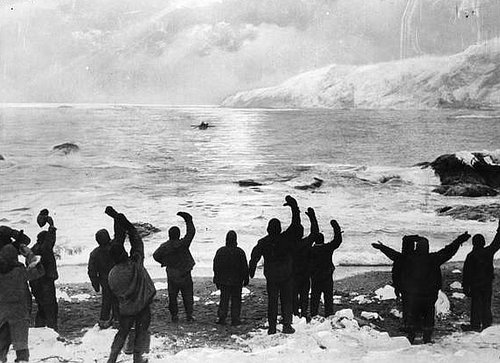
Yesterday marked an auspicious day in the annals of exploration. It was exactly 100 years to the day since Ernest Shackleton's men were rescued from the ice in the Antarctic after a months-long ordeal that would eventually go down as one of the greatest tales of survival ever. The rescue brought and end to their struggles on that particular expedition, but returned them to a world gone mad by war.
Shackleton's tale is a well known one at this point. In August of 1914, he and his men set sail from London for the Antarctic where he and several of his men had hoped to launch an attempt to cross the frozen continent. As they left Europe behind, the first shots of what would become World War I were just taking place on that continent as well.
In December of 1914, Shackleton's ship – the aptly named Endurance – departed South Georgia Island for the Weddell Sea off the coast of Antarctica. Once there, the crew discovered more ice than they had expected, and by January 19, 1915 the ship was fully enveloped in ice, not allowing it to move forward or backward. For months, the Endurance and her crew were stuck in place, until the ship finally succumbed to the pressures being applied to its hull and sunk beneath the waters on November 21, 1915.
But the ordeal for Shackleton and is men were far from over. For weeks they camped on an ice floe before it cracked and broke up, forcing them into the Endurance's lifeboats in a desperate attempt to reach Elephant Island. They reached that point and stepped foot on solid ground for the first time in 497 days.
Knowing that he and his men couldn't hold out forever, Shackleton came up with a desperate plan to make an open water crossing to reach South Georgia again. On April 24, 1916 he and a few hand-picked men set out once again, surviving high seas, storms, and frigid conditions to reach their destination on May 8. They then made a harrowing trip across the island on foot to reach a whaling station on the other side where they could begin mounting a rescue operation at long last.
But once again the conditions in the Southern Ocean thwarted their plans and poor weather prevented them from going back to Elephant Island. On two separate occasions rescue missions were forced to abandon their attempts, although Shackleton persisted in his efforts to save his men. It took until August 30, 1916 to complete the rescue operation, retrieving 22 men who had remained in that desolate place for five more months. But in the end, not a single man perished on that expedition, which remains a remarkable feat to this day.
It took until May of 1917 for Shackleton to return to England, but but that point the war was at its most brutal. A small conflict that was breaking out when he and his men left for the Antarctic had turned into the bloodiest and most costly war that the world had ever seen. Millions had lost their lives since the Endurance had set sail, and hundreds of thousands more would perish before it was through. Some of them were men who had survived all those months on the ice.
I've said it before and I'll say it again. The story of Shackleton and his crew is one of the greatest stories of adventure and survival that we've ever seen. It is a testament to his leadership skills that they managed to stay alive at all, and I can't even imagine what it was like to be stranded under those conditions for so long.
Major thanks goes out to the Adventure Journal for reminding me of this important date in history.
Tampilkan postingan dengan label Survival. Tampilkan semua postingan
Rabu, 31 Agustus 2016
Senin, 29 Agustus 2016
Czech Traveler Survives for a Month in the New Zealand Wilderness After Partner Dies
Here's a harrowing tale of survival that will probably make a great book or film at some point. Last week, authorities found a Czech tourist who had been missing for more than a month in the wilderness of New Zealand. The woman was discovered living in a park warden's hut along the Routeburn Track, one of the country's popular trekking routes. She is said to be in reasonably good physical condition, although she is understandably suffering some physiological stress from the ordeal.
The woman, and her traveling companion set out to hike the trail back on July 26. The Routeburn Track typically takes about three days to complete, but the duo became lost when the trail markers they were following became buried in deep snow.
Things went from bad to worse when the woman's partner fell off a cliff, dying as a result of his injuries. She then spent three long, cold nights out in the open before locating the cabin, which became her home over the past few weeks. During that time she suffered some minor frostbite and hypothermia, but for the most part is in good condition.
Nearly a month past before the Czech consulate contacted authorities in New Zealand, who up until that point were unaware the couple was missing at all. They organized a search party, but held out little hope since it been so long, and so much snow had fallen along the trekking route. But, the couple's car was discovered near the trail head, which initiated a longer search that resulted in the rescue.
In addition to the cold weather and snow conditions, the woman faced a serious threat from avalanches. Most hikers are advised to avoid the higher altitude sections of the hike during the winter months for that very reason. It was because of those dangers that no other hikers discovered her living in the cabin over the past several weeks. She was found last Wednesday and transported to a local hospital for treatment.
Quite a story indeed. She is obviously lucky to be alive. Thankfully this one had a mostly happy ending, although condolences go out to the friends and family of the man who perished on the trek.
The woman, and her traveling companion set out to hike the trail back on July 26. The Routeburn Track typically takes about three days to complete, but the duo became lost when the trail markers they were following became buried in deep snow.
Things went from bad to worse when the woman's partner fell off a cliff, dying as a result of his injuries. She then spent three long, cold nights out in the open before locating the cabin, which became her home over the past few weeks. During that time she suffered some minor frostbite and hypothermia, but for the most part is in good condition.
Nearly a month past before the Czech consulate contacted authorities in New Zealand, who up until that point were unaware the couple was missing at all. They organized a search party, but held out little hope since it been so long, and so much snow had fallen along the trekking route. But, the couple's car was discovered near the trail head, which initiated a longer search that resulted in the rescue.
In addition to the cold weather and snow conditions, the woman faced a serious threat from avalanches. Most hikers are advised to avoid the higher altitude sections of the hike during the winter months for that very reason. It was because of those dangers that no other hikers discovered her living in the cabin over the past several weeks. She was found last Wednesday and transported to a local hospital for treatment.
Quite a story indeed. She is obviously lucky to be alive. Thankfully this one had a mostly happy ending, although condolences go out to the friends and family of the man who perished on the trek.
Langganan:
Postingan (Atom)
