As I get ready to head out of the country once again tomorrow, I wanted to take this opportunity to remind everyone that next Friday – October 14, 2016 – had been declared a National Day of Adventure by Men's Journal and Victorinox, the company behind the iconic Swiss Army Knife.
While not an official holiday of course, the entire point of the NDOA is to encourage people to get outside, engage in their favorite outdoor activities, or perhaps even try something new. To that end, the two sponsors of the Day of Adventure have helped organize more than 30 events across the U.S. to give us all a starting point for getting our adventures off to a good start.
While I'll actually be in Spain on that day, I'll certainly take some time to hit a trail and do some hiking, or possibly even some snorkeling in the Mediterranean Sea. And since it is a Friday, hopefully some of you will take part in the celebration by heading out to enjoy your own adventures too. Why not skip out of work early, grab your mountain bike and take a ride on your favorite trail? Or, gather up some friends and take a scenic hike somewhere before grabbing some dinner and drinks afterwards. The whole point is to add a little excitement and adventure back into your life, something that hopefully we do on a more regular basis than one day a year, but it is a good place to get started never the less.
So, whether your like to ride, hike, run, paddle, fly, climb, or some other crazy outdoor activity, don't forget to set a little time aside to pursue that passion next Friday. After all, you'll never regret the days that you do the things you love, and you might just discover other passions along the way.
This video takes us to the Rätikon Mountains of Switzerland where we join professional climber Kilian Fischuber ons a tough route known as Headless Children. As he makes just the second free climb of this mutli-ptich 250-meter (820 ft) wall, he begins to see an intersection of his two passions, climbing and art. On this wall, he sees colors that are not unlike a painting, adding a surreal element to the entire experience.
Located just 80 meters off the coast of Ireland, the Dún Briste sea stack is an indelible part of one of that country's most iconic landscapes – Downpatrick Head, where St. Patrick himself is said to have built a church centuries ago. While certainly an enticing challenge, the sea stack is seldom climbed, but last month that's exactly what Iain Miller and Paulina Kaniszewska did. In this short video, you'll see them paddle out to the rock face, make their ascent, and take in the views at the top, which include the remains of an old lookout post from World War II.
You can find out more about their experience by reading their account of the climb here. It looks like it was quite a fun adventure. Thanks for sharing Iian!
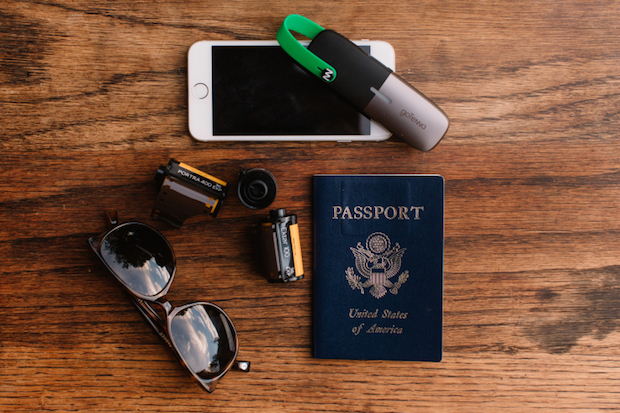
Earlier in the year I took a look at an innovative method for staying in communication while in the backcountry called goTenna. This simple, but effective device, connects to your smartphone via Bluetooth technology, and allows you to send text messages and share your GPS location with others who are equipped with a goTenna of their own. In a sense, the device creates its own data network for use in places where shell service is nonexistent, and while it doesn't facilitate voice comms, I found it very useful for staying in touch nonetheless. Now, the team at goTenna is back with a new product, and while it works in much the same way as its predecessor, it has the potential to extend the range of the device much, much further.
Dubbed the goTenna Mesh, this new unit launched on Kickstarter yesterday. A bit smaller than the original model, this new device brings some interesting new technologies to the table that should make it more useful to travelers, backpackers, climbers, and other outdoor enthusiasts. For instance, the Mesh now operates on UHF radio frequencies, which have brought it's out-of-the-box range down slightly, but make it more adaptable to a wider variety of environments, including both the outdoors and interior spaces. Switching to UHF has also allowed goTenna to bring their product abroad too, opening it up for sale in foreign countries where the previous generation's VHF radio waves were not allowed.
But more importantly, as it's name implies, the goTenna Mesh brings "meshing" technology to users as well. This allows the device to relay data that is sent to it on to other users, thereby extending the range almost indefinitely. Where as the original goTenna simply blasted out the messages that it broadcasted to all other goTenna users in range, the Mesh can analyze the data, and then rebroadcast it to others too. In this way a message that is sent can potentially reach a recipient, even if they weren't in range of the original sender.
The first generation goTenna has a range of about 1 mile in urban settings and 4 miles in rural areas, although greater ranges can be achieved depending on elevation and so on. The goTenna Mesh has a similar range when used for peer-to-peer communications, with 1 mile in cities and 3 miles in the backcountry. But, since it has the ability to relay data, a message can hop from one device to the next, provide there are several of them working within range of one another. So while two Mesh devices might have a range of roughly three miles, three or four units working together could stretch that range considerably further.
When goTenna launched the Kickstarter campaign for the new Mesh model it was with the hopes that it would generate $150,000 in crowdfunding to help get the device into production. Just 24 hours later, the campaign has generated $132,000 and climbing. That means that the new product should begin shipping in December as expected, with a price tag of $179 for two units. Of course, a third goTenna Mesh is really needed to see the true benefits of this second generation model, but this is certainly a good start. Early-bird contributors can reserve their goTenna Mesh units for as little as $129 by pledging to support the Kickstarter campaign now however.
In addition to revealing the Mesh, the company is also launching a new service called goTenna Plus. Users who sign up for this plan receive additional benefits from the goTenna app that is installed on their iPhone or Android device, including improved topographic maps for sharing your location, tracking of speed and distance while out hiking, and even sharing your current location with a designated individual on a set schedule, much like a SPOT Satellite Messenger. goTenna Plus users can also take advantage of network relaying which allows a device that is connected to a cell network to pass along goTenna messages to other users in that way too.
goTenna Plus is normally priced at $29 for a year, but is currently available at an introductory price of just $10. Seems like a pretty reasonable rate to me.
Find out more about goTenna and all of its gadgets at goTenna.com.
Just when we think we've seen it all from blind adventurer Erik Weihenmayer, he comes up with new ways to surprise us. Yesterday, we learned that he not only managed to climb the iconic El Capitan in Yosemite, but he did so in under 24 hours, an impressive accomplishment with or without sight.
Climbing with some of the sport's biggest names – including Hans Florine, Timmy O’Neill, Geoff Tabin, and Charley Mace, Weihenmayer went up the East Buttress route. While that is the shortest path to the top of the famous wall, it still involves 11 pitches and 1500 feet of climbing. He told National Geographic “I wanted something I could free climb, and the length of East Buttress made me feel somewhat confident that I could do it in a day.” That turned out to not be a problem at all, as the squad finished the route in about 8 hours, even passing another team along the way.
This is just the latest in a series of impressive accomplishments by Weihenmayer. His resume also includes a successful climb up Mt. Everest – along with the rest of the seven summits – and a descent of the Colorado River in the Grand Canyon by kayak. Over the years he has climbed numerous mountains, competed in adventure races, mountain biked some tough trails, and generally did a number of very adventurous things that even those of us with full use of our eyes would be lucky to do. He has also served as an inspiration for millions around the world, who have seen the boundaries of what a blind person can accomplish redefined again and again.
This isn't even the first time Weihenmayer has climbed El Cap. He did it 20 years ago with Florine as well. But that time they went up The Nose route, taking four days to complete the 32-pitch, 3000-foot wall. This is the first time any blind climber has knocked off El Cap in a single day however, which is pretty much the mark that all climbers are looking for when they take on the massive wall.
At the top of the East Buttress, the team was met by friends who had cold beer and snacks waiting. It didn't take long for Erik to start talking about his next Yosemite climbing adventure, with Florine chiming in that they should try The Nose again, but this time do it in a day as well. Perhaps that will be the next major challenge for Weihenmayer to undertake. We'll just have to wait to see how he surprises us next.
If you're looking for something to read today that is equal parts inspirational and educational, than have a look at Men's Journal's list of the 50 Most Adventurous Men on the planet. You'll find more than a few names that get mentioned here on The Adventure Blog on a regular basis, as well as some that you may not have encountered before.
The list reads like a "who's who" of adventure, with guys like Alex Honnold, Kilian Jornet, and Conrad Anker all making the cut. Others who earn some recognition from MJ include Ueli Steck, Eric Larsen, and Mike Horn, all of which I've written about and covered their expeditions extensively on this very website.
Of course, those well known names are just the tip of the iceberg so to speak, with numerous other interesting, daring, and downright visionary individuals making their way onto the list as well. The article spotlights mountaineers, rock climbers, ocean rowers, explorers, and more. Each of the profiles includes a brief introduction to the person's accomplishments, some insights into their career highlights, and a glimpse of where they may be headed next. All in all, it is a pretty great way to learn about some of the men who are shaping the way we explore the world today.
While 50 individuals is a fairly lengthy list, there are always some who are left off. I'm sure that like me, you'll be able to think of a few individuals that probably deserve to be mentioned with this group such as Simone Moro for instance. There are others as well, but this is still a pretty interesting list and well worth a look for sure.
Now, when is someone going to do a list of the 50 most adventurous women?
Looking for a great town to serve as base camp for your next outdoor adventure? Thinking about relocating to a place that offers more opportunities to pursue the things you love? Why not let National Geographic help with their picks for the world's best towns for outdoor thrills. Some of the places earning a nod include towns that you would expect. Places like Moab, Utah and El Chaltén, Argentina. Others are a bit more unexpected, such as Niseko, Japan or Ely, Minnesota. It isn't as if those places weren't known for being great outdoor destinations, but to see them ranked amongst the very best (Nat Geo names nine places in total), is refreshing to say the least.
Each place is also accompanied by a nice description of why it deserves a spot on this very distinguished list with details on what it has to offer for visitors. Nat Geo even provided information on when it is the best time of the year to visit to take advantage of the opportunities that each place has to offer. For instance, summer can be hot in Moab, so September is a good time to go, although the author says not to overlook winter as well. Meanwhile, if you're planning on going to Niseko it is probably for the skiing, which is best between December and February.
Of course, with such a short list some places had to be left off, but there were a few surprises for towns that do not appear here. For instance, Chamonix, France is considered one of the great outdoor meccas of the world and yet it doesn't appear on Nat Geo's radar. Similarly, you could just as easily have substituted places like Boulder, Colorado or Jackson Hole, Wyoming, amongst other great mountain towns in the U.S. Still, the places that were selected are very deserving, and bring a nice exotic flair to the list with places like Australia, South Africa, India, and Peru enticing travelers.
To find out which places made the cut, read the entire list here. Then come back and leave a comment with the places that you think should have made the cut. After all, some of your favorite places probably didn't make it.
In this video, we'll head to China's White Mountains to go rock climbing with Liu Yongbang, one of that country's promising young climbers. Yongbang, who is also known as "Abond" in climbing circles, attempts a route called Hot Dumpling, which has a rating of 5.14d. For those who don't know, that would put it amongst the most difficult climbs on the planet. Along the way, we'll get some unforgettable footage of the surrounding countryside as well, giving us a glimpse of some of China's great climbing opportunities, which are often overlooked.
As the 2016 Olympic Games continue to unfold in Rio, there was big news about the 2020 games this week – at least for the outdoor community. The International Olympic Committee (IOC) had officially announced that climbing, surfing, and skateboarding will all be a part of the next Olympics, which will be held in Tokyo, Japan.
For some, the announcement came as good news, with professional climbers, surfers, and skateboarders applauding the decision. Others have shrugged it off as a non-event, saying that the Olympics are far from the venue that they want to use to promote their sports. Alex Honnold, for instance, told Reutershat he probably wouldn't even be able to qualify, as "Competitive climbing is basically a whole different sub-sport.” He went on to add that he'll probably be on a solo expedition somewhere instead.
The surfing community has expressed a similar sentiment as outlined in this story from Outside magazine. Surf legend Kelly Slater says he'd love to compete, while others have not been so quick to embrace the Olympic spirit. Owen Wright eloquently summed up his feelings on the matter by saying “Fuck the Olympics.”
Either way, these sports will be a part of the games in four years, and it should be interesting to see how they play with a larger, more mainstream audience. I don't expect to see climbing televised, but both surfing and skateboarding will hold an appeal for sure. Whether or not viewers embrace these additions remains to be seen, but at least they are getting some recognition, even if the best athletes in each sport may not actually be there to take part.
As for the current Rio games, it has been a bit of a mixed bag for me so far. On the one hand, it is always great to see these world-class athletes competing on such a big stage. But on the other hand, the amount of trouble that has been taking place in and around the Olympic venues is a bit disturbing. Athletes getting robbed, dignitaries held up at gun point, violence in the streets. Not a lot of those stories are making it to the mainstream press, but they are happening on a regular basis. If you haven't seen the current episode of Real Sports with Bryant Gumble on HBO yet, I would urge you to do so. It'll give you an entirely new perspective on the games, the IOC, and the process of determining where the Olympics are held every four years.
A few days back, Oakley completed a solo summit of Yosemite's most iconic route in 21 hours and 50 minutes. That shaved more than 2.5 hours off the previous record, which was set by Chantel Astorga back in 2014. Astorga went up the nose in 24 hours, 39 minutes, which means Oakley is also the first woman to break the 24-hour mark as well.
The Nose has a long and storied history in climbing. It is considered one of the most famous routes in all of rock climbing, requiring equal parts skill, strength, and stamina to complete. Rated a 5.9 C2, the classic ascent is a 3000-foot monster that tests the dedication and determination of any climber. Oakley did it solo for the first time last year, completing her climb in a little under 27 hours.
For reference sake, the current speed record on The Nose for a two-person team is held by Hans Florine and Alex Honnold. That talented duo managed so complete the route in 2 hours, 23 minutes, and 46 seconds. The solo record for men is held by Tommy Caldwell, who topped out in just under 12 hours.
Congratulations to Miranda for an impressive display of skill and strength. Well done!